Friday – Home – Earlier in the week we had a new door fitted between the passage between us and the museum. An expensive but very well made piece of woodwork. Yesterday I painted on a coat of primer and put a second coat on today. A Nuthatch is calling from the trees. There is the frequent retort of Horse Chestnut conkers falling in the wind and bouncing loudly off the summerhouse roof.
Leominster – I cross the Grange and head down to the Millennium orchard. Despite the brisk wind of recent days, not many more apples have fallen. Genet Moyle and Ladies Fingers are still on the tree in good numbers, Dabinett are fewer. The sun is hot on my back as I walk northwards through the Millennium Park but ahead the sky is dark with rain-filled clouds.
Into the churchyard. A Nuthatch is calling. I have not heard many for some time but they are now both here in the churchyard and in our garden. A small patch of Borage is in among Stinging Nettles and whorls of Spear Thistle leaves.
Sunday – Leominster – It was a starry night with Orion glittering in the southern sky. The sun shines in the morning through wispy high cloud. There is autumnal chill to the air. Robins are in song and there is the ever present chack of Jackdaws. Onto the Grange. A Nuthatch calls from one of the Beeches. The Traveller’s Joy/Old Man’s Beard on the flat opposite the Community Centre has now reached the guttering. Along Paradise Walk. The River Kenwater remains clear and shallow. On to Ridgemoor Bridge. Something swirls the water but is hidden by the reflection of the sky. The shingle bank indicates that the River Lugg has risen just a little.
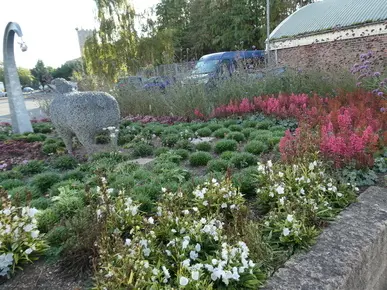
The market is larger than in recent weeks. As usual I purchase nothing. Back to Ridgemoor Bridge. Upstream Himalayan Balsam is still in flower. A few Snow Berries are on the bushes but not in the usual numbers. Into Paradise Walk again. A Kingfisher flashes down the Kenwater. Two Mallard are downstream from Priory Bridge. Through Bridge Street car park. The flower bed with the metal Ryeland sheep is still looking good with purple and white dwarf Canterbury Bells, Sedum, Thrift, Verbena and red and white Heuchera in flower.
Home – I rip out all the callaloo from one bed and dump it into the chicken run. The other large patch on another bed will have to wait. The bed is then harrowed. Tomatoes are left for one more week, then they will have to come out. The grass needs cutting but that job will have to wait firstly until it is dry and secondly after all the conkers have been removed.
Monday – Carnforth – A market town and civil parish in the City of Lancaster situated at the north east end of Morecambe Bay. The origin of the town name has several suggestions: Chreneforde or Cranford, a ford with cranes, or a ford of the River Keer which flows to the east of the town. Large deposits of limestone located locally made Carnforth an ideal place for an ironworks, as limestone is a key component of the smelting process. In 1846, the Carnforth Ironworks Company established a works near to the railway station. Iron production ceased in 1929. The village had grown in the 19th century, largely as a railway town. The Lancaster Canal passes through the town.
The Heritage Centre is in the station. Trains on the West Coast mainline pass at great speed. A lot of the centre features the 1945 David Lean film Brief Encounters which was largely filmed here. Carnforth railway station was opened on 22nd September 1846 by the Lancaster and Carlisle Railway (L&CR). It became a junction in 1857, when the Ulverstone and Lancaster Railway arrived from the north-west; the station serving as the line’s southern terminus. The Furness Railway took over the U&LR in 1862 and became the second major company operating to Carnforth. The station was enlarged during the 1870s and in 1880 trains from the Midland Railway used it, following the commissioning of a south-to-east direct curve to the Furness and Midland Joint Railway, creating a triangular junction. The L&CR was taken over by the London and North Western Railway (LNWR). The Furness Railway erected a distinctive stone-built signal box to the north-west of the station in 1882, used until 1903, and this survives preserved as a grade II listed building. A 300 yard long platform (currently used by northbound services), was started in 1938. In 1942, the Carnforth depot was expanded to become a major regional depot. After closure it was developed as a museum, but this was not successful and it now acts as the major national operational base of West Coast Railways.
Up Market Street. There is a reasonable range of shops, chemists, post office, dentist, pet supplies and, of course, a good number of charity shops. A large former bank is now a solicitors. Up the hill past The Shovel Inn of 1750, the oldest pub in the town, to a bridge, indeed two bridges, over the Lancaster Canal. One is a traditional stone canal bridge, the other a tubular steel footbridge. We walk a very short section of the canal before returning towards the centre.
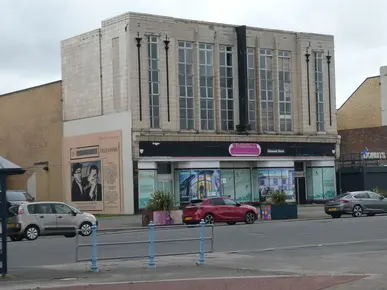
Past Christ Church was built in 1875 by Brade and Smales with a north aisle of 1900 and a tower at west end of the south nave wall of 1908 by W Gilbee Scott. Opposite is the old Police Station. It is, of course, locked. We are staying in the Royal Station Hotel built in 1880. Opposite is the former cinema, opened as the Kinematic Theatre in 1920, later renamed The Roxy, and eventually closed in the mid 1960s and now a supermarket. It has large, rather pretentious stone columns.
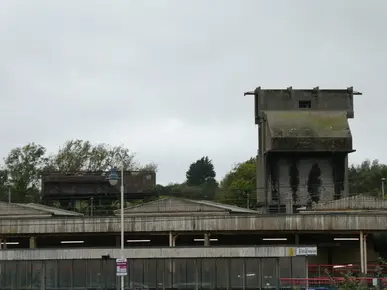
Tuesday – Carnforth – Fine drizzle greets the morning. Warton Street rises over the railway. A row of shops lined one side, half empty. The former Post Office was a restaurant, now closed. Down down the other side of the bridge. Across the tracks are rows of carriages and diesel locomotives part of the Western railway centre. Beyond are two tall concrete towers; the coaling plant, the ash plant and an iron water tower, all constructed in 1939/40. On this side of the tracks, behind a tall wall, is the old signal box mentioned above. Across the road are the offices of the Carnforth Ironworks.
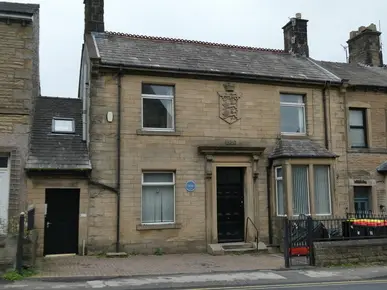
Back over the bridge and into Hunter Street. It is lined with terraces of well-built stone houses, just a few ruined with pebble-dashing. It is a dead end so I returned to the main road. A small square contains the War Memorial and the fire station. The Carnforth Hotel stands on the crossroads.
Tebay – Into what has become an iconic service station on the M6. It is what one usually thinks of as a typical Cumbrian day, wet and cloudy. Sheep stand motionless on the rough moorland in the drizzle. Mallard test beside a large pond, entering the water occasionally for a dabble.
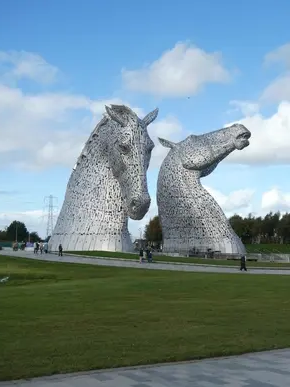
The Kelpies - A pair of steel horse-heads between the Scottish towns of Falkirk and Grangemouth. They stand at the end of the Falkirk canal, now called the Elizabeth II canal, next to the M9 motorway. Each head is 98 ft high and weighs approximately 300 tonnes. The sculptures were designed by sculptor Andy Scott and were completed in October 2013. A kelpie is a shape-shifting water spirit haunting the lochs, rivers, and streams of Scotland to lure unwary travellers to their deaths. The sculptures are based on Clydesdale draught horses, specifically Duke and Baron. Inevitably, Jackdaws are attracted to the spaces between the steel plates. Around the sculptures is an area of parkland known as the Helix. Part of the Canal is drained, now full of reeds and Purple Loosestrife.
Stirling - We are staying at the Scottish Highland hotel in a former 19th century Victorian high school on Spittal Street. We walk up the street. Opposite the hotel is the former Spittal hospital built in the 17th century. The Erskine Church was erected in 1740 for Revd Ebenezer Erskine and his seceding congregation; he died in 1754 and was buried within this building. The old church was replaced in 1824-6 by a classical building, now the Youth Hostel. Now only its façade remains. In front of the Youth Hostel and on the site of the original church is the Ebenezer Erskine Monument. It was erected in 1859 by Peddie & Kinnear, a 30-foot-high classical domed sandstone ashlar monument standing over the site of Erskine’s grave. On up the hill, now St John Street. A house has a stone lozenge with a pair of scissors over the door which serves as a tribute to Robert Spittal, a 16th century philanthropist and the official tailor to Queen Margaret, wife of King James IV. The old jail is a tourist attraction. It opened in 1847, designed by architect Thomas Brown, and built according to the Separate System devised by William Brebner. Opposite is the Boys Club, a 17th century house converted in 1929 by Eric Bell. A motto above the door reads “Play the Game”, above the window on the left, “Keep Smiling”. Bruce Of Auchenbowie’s House, on land bought by Robert Bruce, Provost of Stirling (descendant of The Bruce) in 1555, is 16th century with a stair tower. Cowane’s Hospital was built by John Cowane, a merchant and philanthropist, in 1634-1661 by James Rynd, master mason to a design by John Mylne.
Opposite is the Church of the Holy Rude (Eaglais na Crois Naoimh) is the medieval parish church of Stirling, Scotland. It is named after the Holy Rood, a relic of the True Cross. The church was founded in 1129 during the reign of David I, but the earliest part of the present church dates from the 15th century. As such it is the second oldest building in Stirling after Stirling Castle, parts of which date from the later 14th century. The chancel and tower were added in the 16th century. James VI of Scotland, James I of England, was anointed King of Scotland here in 1567, the sermon preached by John Knox. In the 17th century there was a dispute, a severe theological and political schism, between two ministers, James Guthrie and Mathias Simpson which resulted in a wall being built between the nave and chancel which was not removed until 1935. There are two fine modern pieces of glass: the Guildry Window installed in 1993, designed by Crear McCartney, dedicated to the city’s merchant guild and the Argyll and Sutherland Highlander which was installed on July 1st 2016, made by the Christian Shaw studio. The east window is dedicated to John Coward and by James Ballentine of Edinburgh. The organ four-manual instrument was built by Rushworth and Dreaper in 1939, the largest romantic pipe organ in Scotland. On the north side of the choir is a Easter Sepulchre. The pulpit is 17th century, reconstructed in 1911-14. There are four bells: Two by Chapman 1781, one by Ouderogge 1657, and one 15th century.
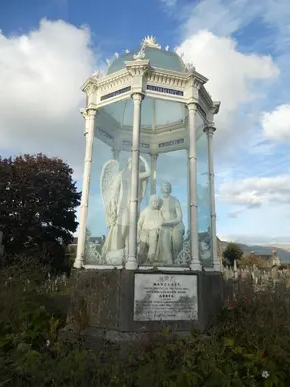
Between the church and the castle are several extensive cemeteries. A path leads to Ladies’ Rock, an outcrop giving a panoramic view of the Forth valley. The Wilson Monument is an iron and glass cupola containing a marble group of two girls and an angel, the daughters of Gilbert Wilson, a committed Episcopalian. Despite this, the sisters were followers of the Covenanters, an extreme Presbyterian group strongly opposed to the Anglican reforms of Charles II. Margaret and Agnes, aged 18 and 13 respectively, were arrested for their beliefs and along with Margaret McLauchlan, an elderly neighbour, tried for and found guilty of high treason. All three were sentenced to death by drowning. Agnes’s father was able to buy her freedom but despite a temporary reprieve the others were led to a point below high water mark on the treacherous Solway Firth, tied to stakes, and left to drown in the incoming tide. A young Mistle Thrush searches for food between the gravestones.
At the foot of the churchyard is Mar’s Wark, a now ruined building built 1570–1572 by John Erskine, Regent of Scotland and Earl of Mar. The Erskine chief had become hereditary keeper of Stirling Castle where the princes of Scotland were schooled. Wark is a Gaelic word for work but here it means building.
Down Broad Street. The Merkat Cross was a 16th century heraldic cross, removed in 1792 and restored in 1891. A unicorn at the top is the only original part of the cross. Houses here are a mixture ranging from the 17th to 19th centuries, often rebuilt in that period. At the bottom of the street is a bagpipe manufacturers. The Tollbooth was the jail until 1847. Into Baker Street where tall tenements are 19th century. Finding a decent pint proves tricky and we end up in a Spoons, The Crossed Peels, which is on the ground floor of a 1960s office block, built on the site of McCulloch & Young’s department store. Established in 1893, it was Stirling’s largest store, with frontages on Baker Street and Spittal Street. Baker Street was previously named Baxter’s Wynd. The bakers, or baxters, were one of Stirling’s seven ancient craft guilds. Their emblem was two crossed baker’s shovels, known as crossed peels.
Wednesday – Stirling – We walk up the hill to Stirling Castle. All across the valley of the River Forth is an inversion layer, cloud above the lower land then higher up clear skies. The Wallace Memorial pierces the layer on the far side of the valley. The castle is busy with tourists and large numbers of foreign students, most of whom are somewhat disinterested in Scottish history. Stirling Castle – Caisteal Shruighlea – stands on the Stirling Sill, a formation of quartz-dolerite around 350 million years old, which was subsequently modified by glaciation to form a “crag and tail”. To the west of the castle buildings is a 250 foot cliff to the fields and A811 below. The King’s and Queen’s Knots, grass mounds which were part of the castle gardens. The first castle dates from around 1110, when King Alexander I dedicated a chapel there. The castle switched hands numerous times between the Scots and the English over the next couple of hundred years. Robert II (reigned 1371–1390) and Robert III (reigned 1390–1406), built the earliest surviving parts of the castle.
Almost all the present buildings in the castle were constructed between 1490 and 1600, when Stirling was developed as a principal royal centre by the Stewart kings James IV, James V and James VI. The architecture of these new buildings shows an eclectic mix of English, French and German influences, reflecting the international ambitions of the Stewart dynasty. After James VI became James I of England and Scotland the castle was no longer a royal residence but a military centre. It was taken by Cromwell during the Civil War. It played a role in both Jacobite Risings.
From 1800 the Castle was owned by the War Office and run as a barracks. Many alterations were made to the Great Hall, which became an accommodation block, to the Chapel Royal, which became a lecture theatre and dining hall, to the King’s Old Building, which became an infirmary and to the Royal Palace, which became the Officer’s Mess. The Argyll and Sutherland Highlanders had its depot in the barracks in 1881. Although it remains the headquarters of the Argyll and Sutherland Highlanders, extensive restoration has been undertaken in the 21st century.
We leave the castle and follow a road round to the Stirling Distillery where a purchase is made. Kay retreats and I plod on. Back into Baker Street again. A tall brick and half timbered building designed as business chambers and tenement by local architect John Allen 1846 to 1922. Rather out of keeping to the rest of the tenement buildings around here.
Baker Street enters King Street, into the shopping area. On the junction is Burgh House designed by William Stirling of Dunblane and built 1816-1817 as a Classical gentlemen’s club by Allan Johnstone, contractor; the porch added in 1859, with Loyalty and Liberty on the sides of the arches and a statue of William Wallace on top. Opposite is the former Clydesdale Bank, built in rich red stone, designed by James Thomson of Glasgow architect firm, Baird and Thomson and dated 1900. On down King Street, the Bank of Scotland, built around 1840, is empty. The Co-operative Society 1880, is two businesses. The Golden Lion of 1786 is still a hotel, with a gold lion over the porch. At the bottom of the road is another former Bank of Scotland building, now offices. It was the former premises of Stirling Tract Depot built by J, W H and J M Hay of Liverpool in 1862. Into Port Street. A four storey red stone building of 1840 actually contains the Bank of Scotland! The street contains a number of national chain stores. Into Upper Craig. This is the cheaper end with a number of empty premises, including a former butchers.
Back to Port Street and into the modern shopping arcade. Within, down a spiral staircase is the Bastion and Thieves Pot. The Bastion was a corner tower of the Burgh Wall. Beneath, in the mid 16th century, was the Thieves Pot, a cramped dungeon. After the Jacobite surge of 1746, much of the Burgh Wall was dismantled. Thieves were now imprisoned in the cells of Sir William Bruce of Kinross’s Tollbooth in Broad Street. It was condemned as the worst jail in Britain and was replaced by the New County Jail, now the Old Jail, in 1847.
Out and around the corner into Dumbarton Road. Here there is a section of the old town wall. Allan Park South Church was designed by Peddie and Kinnear of Edinburgh, and built in 1867 and is for sale. A short distance along the road is a statue of Robert Burns by Albert Hemstock Hodge unveiled in 1914. Nearby is the War Memorial by G R Davidson of Stirling and erected in 1922. Across Corn Exchange Road is Albert Halls by W Simpson Jnr. built in 1883 as a concert hall and still used as a cultural venue. On the other side of Dumbarton Road are mainly 19th century houses in various designs.
Up Corn Exchange Road past a statue of Robert Roy McGregor, who has lost the blade of his sword. A statue of Henry Campbell-Bannerman, Prime Minister 1905-1908, by H Ramsay Taylor of Edinburgh and erected in 1904 stands on the corner of Back Walk. Opposite is the Carnegie Public Library also designed by H Ramsay Taylor in 1904. Up Back Walk. Here there is a long section of the old Town Wall with ruined bastions. Further up the Back Walk is a wall plaque “Erected in owner of Robert Spettle, Taylor to the King James the Fourth donor of the hospital in this burgh for relief of decayed tradesmen The liberal man devises liberal things”. Below is another: “Here in The Old Grey fryer yaird stood the Hall of the Seven Incorporated Trades of Stirling from 1751 to 1907.” This is the back wall of our hotel.
Thursday – Heversham – A small village in the South Lakelands that stood on the A6 but was bypassed in the 1920s. An abbey was established here in the early Anglo-Saxon period. According to the Historia de Sancto Cuthberto, in the early 10th century its abbot, Tilred, purchased the village of Castle Eden and gave half of it to Norham abbey so that he could be abbot there, perhaps because Heversham Abbey had been destroyed by the Vikings.
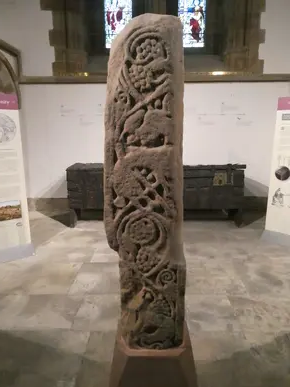
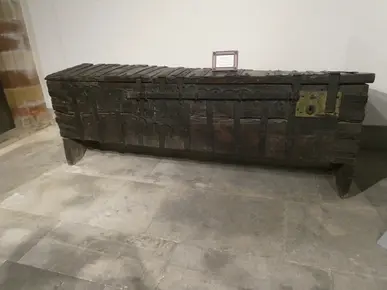
The church of St Peter dates from the 12th century. Additions and alterations were made during the following centuries. Rebuilding took place following a fire in 1601. Restoration was undertaken in 1868 by the Lancaster architects Paley and Austin, who also added the tower. The south door is a fine mediaeval example. In the base of the tower is a portion of an Anglo-Saxon cross dating from the late 8th century, carved with vine scrolls and beasts. It was found under the porch and possibly belonged to the abbey. Here also is the Parish Chest, dating from around 1400 and survived the 1601 fire. Some of the stained glass in the south chapel is dated 1601. The glass in the east window was designed by William Warrington in 1844, and the glass in the south windows is mainly by Clayton and Bell. In the north chapel is a window dated 1914 by Shrigley and Hunt, and the west window of 1924 is by A K Nicholson. A three-manual organ is housed in a carved wooden case dated 1887 and is by Wilkinson of Kendal. It is at least the third organ here, the earliest known was destroyed in the 1601 fire and the second in the Civil War. The church contains a number of monuments, the oldest dated 1626. There is a ring of six bells, all cast in 1870 by John Warner & Sons. At the north end of the churchyard is the former school built in 1838 as the first Girls School in Heversham at the expense of James J Gandy of Kendal.
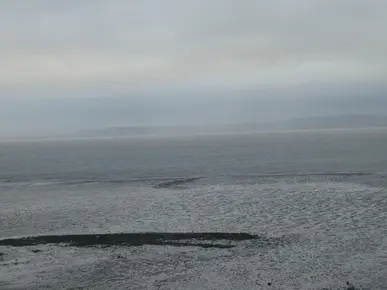
Morecambe – A seaside town on Morecambe Bay. In 1846, the Morecambe Harbour and Railway Company was formed to build a harbour on Morecambe Bay. The town grew around here and became a popular holiday destination, especially for families from Yorkshire because of the rail link. However, Morecambe suffered a decades-long decline after a series of incidents that damaged tourism and the local economy. Two piers were lost: West End Pier was partly washed away in a storm in November 1977, and the remnants were demolished in 1978; Central Pier, damaged by fire in 1933, was removed in 1992. The largest Pontins resort closed in 1993. In 1994, The World of Crinkley Bottom attraction in Happy Mount Park closed only thirteen weeks after opening.
We are staying on the seafront. Opposite the hotel is the famous statue of Eric Morecombe by Eric Ibbeson. Born John Eric Bartholomew here, he took his stage name from the town and with his comedy partner, Ernie Wise, had many years of success until his death in 1984. Out to the west from the promenade is a large expanse of muddy sand. A few birds are on the edge of the distant water, Oystercatchers, Shelduck and a Redshank. Shops along the seafront are an odd mix. There are actually few of the typical tourist places, others include a bed shop, fly fishing centre, army surplus, charities etc. one closed café was The Tivoli, which has panels relating the history of the Tivoli Gardens in Copenhagen, now slowly rotting away.
The Winter Gardens date from 1896, designed by Mangnall and Littlewood. The faéade is of red terracotta and brick. Former Woolworths and Littlewoods by J S Quilter & Son are a few yards apart and are notable faience-clad commercial buildings from the era representing interwar high-street Moderne design. Both now are empty. Opposite is the iconic Midland Hotel built in 1932-3 by Oliver Hill. It is built in concrete and rendered brickwork, painted white in a curved plan, with convex side facing west towards the sea. Three seahorses, painted red, high on tall mullions were carved by Eric Gill. The area is crowded with hire vans, all loaded with filming equipment. An episode of a new “Poirot” programme is being made.
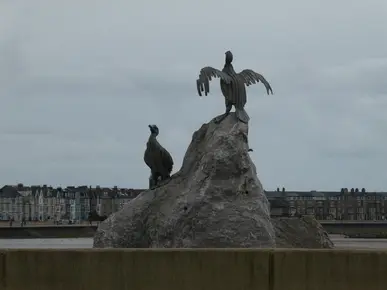
In front of the hotel, the area is being dug out and an Eden Project installation is planned. Seawards are large rocks with iron statues of Cormorants. A harbour arm contains the old station building of the early 1850s, with a lighthouse added shortly afterwards.
Across the main road is the former railway station. It opened in 1907, re-using walling stone and dressings transferred by the Midland Railway from their earlier station in Northumberland Street which was built in the 1870s. It was possibly designed by E G Paley. Much of the shopping area behind the seafront is modern with just the former bank of 1900 in the Bavarian style being notable.
Sunday – Leominster – A cool morning with high, thin cloud. Magpies, Jackdaws and Wood Pigeons call. Across the Grange. A Great Spotted Woodpecker and Carrion Crows are vocal here. Onto Priory Bridge. The River Kenwater remains unchanged; shallow and clear. Along Mill Street. Four Canada Geese fly south. The gravel bank in the River Lugg remains a similar size to recent weeks and now plants are growing on it.
The market is much smaller this week. Back to Ridgemoor Bridge. Clouds are thickening in the west. Back along Paradise Walk and up The Priory to the churchyard. The bells ring out the hour and call to prayer. Grey Squirrels are everywhere, chasing across the grass. A few minutes later bell practice begins.
Wednesday – Leominster – Breezy but mild with clouds thickening in the west. Through Pinsley Mill. There is a total absence of bird calls. Even the Jackdaws on a roof are silent. Into the orchard. It does not seem there will be enough cider apples to make another collection worthwhile. I will check again next week. A Blue Tit chatters. The Blackthorn in the Millennium Park are still heavy with sloes. The River Kenwater remains shallow and clear. Blackbirds yammer alarm calls, Magpies chunter.
Into the churchyard. A Red Admiral butterfly flies up into the air, swirls around in the breeze before dropping back down onto the grass. A dozen Grey Squirrels are dashing around by the large Yews.
Friday – Hereford – Black-headed Gulls screech as they sail to and fro across the River Wye. The water level is very low. A Moorhen flies out from the bank and lands in the middle of the water. It carefully watches a Black-headed Gull that goes over to see what it is may have found. A few Mallard are on the water and a couple on the base of the cutwater of the old bridge. Upstream a few rowing skiffs are pulling away from the rowing club, past a pair of Mute Swans.
Into the cathedral for a few minutes peace and quiet. However, not only is it fairly busy with visitors and a large stage and sound system is being set up in front of the altar. So back into the city centre. By the time I drive out of the city the traffic is horrendous. Little of it appears to be commercial traffic simply moving through on the A49, so it is hard to see what advantage there is spending millions of pounds of taxpayers money and causing considerable historical and environmental damage building a by-pass.
Sunday – Leominster – Sun shines through tufts of high cloud that drifted slowly north west. The Manchester to Málaga 787 flies over. Jackdaws search the car park for breakfast. A Robin sings from a tall thin conifer. A Blue Tit creeps up a lower branch seeking hidden invertebrates. Across the Grange where waggy dogs sniff everywhere or chase balls. Pinsley Road is shaded from the sun and noticeably cool. House Sparrows chirp in the hedge by the old school.
On to Priory Bridge. The River Kenwater is unchanged. Blue Tits flit around the trees above. Yellowing leaves glow like polished brass. Along Paradise Walk. A Kingfisher flashes downstream. The strangulated screech of Grey Squirrels come from the trees.
A cold wind blows across the market field. The field beside the market that held a cereal crop this year is covered in green leaves, probably oilseed rape. The market is larger than last week. Back out over Ridgemoor Brook and along the track. The water level in the River Lugg looks lower this week.
Home – I clear Ivy off the back wall. It has grown into a large mass over the gate and to one side. It is a filthy job, the dust gets into lungs making me cough, eyes and nose streaming. A small Holly grows in the space by the door through the wall is trimmed. The door is permanently blocked. Getting the Hippo Bag full of the debris of Ivy and Holly back around through the alley to the coach garage is difficult; the bag is too heavy to get onto my back so I have to lift and drop it all the way back.
Sunday – Leominster –The annual farce of the end of British Summer Time. It has been a grey week and by the end we have two named storms. On Friday Storm Austen, named by the Met Éireann after its first Director, passed through the English Channel and brought strong winds and rain but little damage in Herefordshire. Over the weekend, Storm Boelo, named by the Dutch National Weather Service (KNMI) and meaning “brave” or “strong” – a traditional male first name, has passed through the north of Ireland and Scotland. Again, here we had a strong wind and a lot of leaves swirling around.
The morning is bright with small clouds gliding south and thicker clouds building in the west. There is still a brisk breeze. The last market of the year has been cancelled because of the weather. The bridge over the railway to the River Lugg remains closed and probably will be for some time yet, despite Railtrack’s promises to open it in early November.
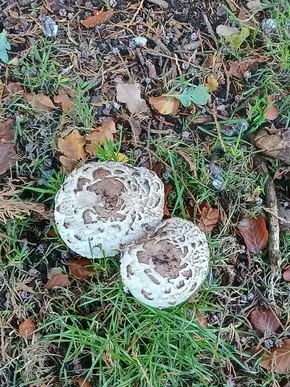
Into Pinsley Mill. An occasional Jackdaw is the only bird sound to be heard. In the orchard some apples are down but again not really enough to warrant collecting. Leaves on most trees are beginning to turn multitudinous shades of yellow and brown. Fresh molehills have been thrown up at the entrance to the Peace Park. The water level in the River Kenwater has risen. The hour rings from the Minster but not the call to prayer does. Maybe the clocks have not been adjusted yet. The sonorous tones of the organ can be heard outside the church. The leaves are being swept out of the porch although that may be a very temporary cleaning. Bell practice starts, so some reset their clocks. Shaggy Parasol fungi, Macrolepiota rhacodes, are under a large conifer in the churchyard.
Monday – Leominster – The Hunter’s Moon shines a pale yellow through thin clouds. Rain falls all morning and the afternoon is damp and grey. The hens’ egg laying is slowing up. The bird feeders are busy: House Sparrows, Coal, Blue and Great Tits. Jackdaws still try to get to the seed but are quickly discouraged. Evening comes early.
 The shingle bank indicates that the River Lugg has risen just a little.
 of the smelting process. In 1846, the Carnforth Ironworks Company established a works near to the railway station. Iron production ceased in 1929. The village had grown in the 19th century, largely as a railway town. The Lancaster Canal passes through the town.
 stone-built signal box to the north-west of the station in 1882, used until 1903, and this survives preserved as a grade II listed building. A 300 yard long platform (currently used by northbound services), was started in 1938. In 1942, the Carnforth depot was expanded to become a major regional depot. After closure it was developed as a museum, but this was not successful and it now acts as the major national operational base of West Coast Railways.
 Sheep stand motionless on the rough moorland in the drizzle. Mallard test beside a large pond, entering the water occasionally for a dabble.
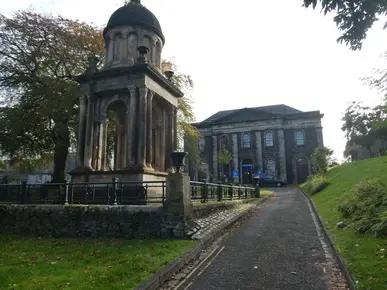 Hostel. Now only its façade remains. In front of the Youth Hostel and on the site of the original church is the Ebenezer Erskine Monument. It was erected in 1859 by Peddie & Kinnear, a 30-foot-high classical domed sandstone ashlar monument standing over the site of Erskine’s grave. On up the hill, now St John Street. A house has a stone lozenge with a pair of scissors over the door which serves as a tribute to Robert Spittal, a 16th century philanthropist and the official tailor to Queen Margaret, wife of King James IV. The old jail is a tourist attraction. It opened in 1847, designed by architect Thomas Brown, and built according to the Separate System devised by William Brebner. Opposite is the Boys Club, a 17th century house converted in 1929 by Eric Bell. A motto above the door reads “Play the Game”, above the window on the left, “Keep Smiling”. Bruce Of Auchenbowie’s House, on land bought by Robert Bruce, Provost of Stirling (descendant of The Bruce) in 1555, is 16th century with a stair tower. Cowane’s Hospital was built by John Cowane, a merchant and philanthropist, in 1634-1661 by James Rynd, master mason to a design by John Mylne.
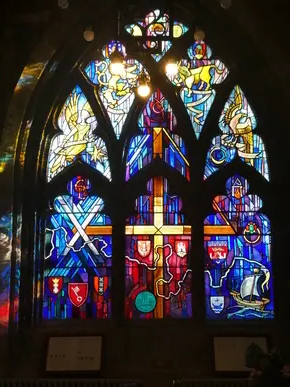 relic of the True Cross. The church was founded in 1129 during the reign of David I, but the earliest part of the present church dates from the 15th century. As such it is the second oldest building in Stirling after Stirling Castle, parts of which date from the later 14th century. The chancel and tower were added in the 16th century. James VI of Scotland, James I of England, was anointed King of Scotland here in 1567, the sermon preached by John Knox. In the 17th century there was a dispute, a severe theological and political schism, between two ministers, James Guthrie and Mathias Simpson which resulted in a wall being built between the nave and chancel which was not removed until 1935. There are two fine modern pieces of glass: the Guildry Window installed in 1993, designed by Crear McCartney, dedicated to the city’s merchant guild and the Argyll and Sutherland Highlander which was installed on July 1st 2016, made by the Christian Shaw studio.
 The east window is dedicated to John Coward and by James Ballentine of Edinburgh. The organ four-manual instrument was built by Rushworth and Dreaper in 1939, the largest romantic pipe organ in Scotland. On the north side of the choir is a Easter Sepulchre. The pulpit is 17th century, reconstructed in 1911-14. There are four bells: Two by Chapman 1781, one by Ouderogge 1657, and one 15th century.
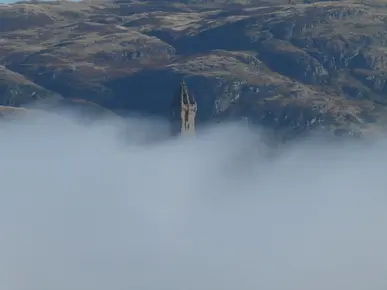 castle is busy with tourists and large numbers of foreign students, most of whom are somewhat disinterested in Scottish history. Stirling Castle – Caisteal Shruighlea – stands on the Stirling Sill, a formation of quartz-dolerite around 350 million years old, which was subsequently modified by glaciation to form a “crag and tail”. To the west of the castle buildings is a 250 foot cliff to the fields and A811 below. The King’s and Queen’s Knots, grass mounds which were part of the castle gardens. The first
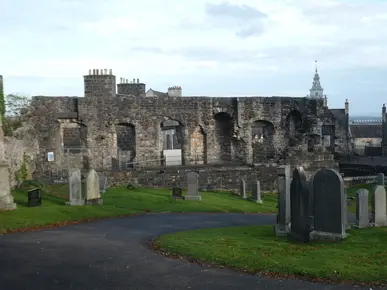 castle dates from around 1110, when King Alexander I dedicated a chapel there. The castle switched hands numerous times between the Scots and the English over the next couple of hundred years. Robert II (reigned 1371–1390) and Robert III (reigned 1390–1406), built the earliest surviving parts of the castle.
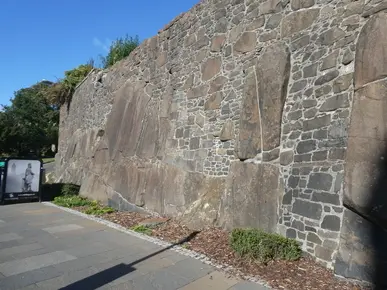 Back to Port Street and into the modern shopping arcade. Within, down a spiral staircase is the Bastion and Thieves Pot. The Bastion was a corner tower of the Burgh Wall. Beneath, in the mid 16th century, was the Thieves Pot, a cramped dungeon. After the Jacobite surge of 1746, much of the Burgh Wall was dismantled. Thieves were now imprisoned in the cells of Sir William Bruce of Kinross’s Tollbooth in Broad Street. It was condemned as the worst jail in Britain and was replaced by the New County Jail, now the Old Jail, in 1847.
 A small village in the South Lakelands that stood on the A6 but was bypassed in the 1920s. An abbey was established here in the early Anglo-Saxon period. According to the Historia de Sancto Cuthberto, in the early 10th century its abbot, Tilred, purchased
 the village of Castle Eden and gave half of it to Norham abbey so that he could be abbot there, perhaps because Heversham Abbey had been destroyed by the Vikings.
 Morecambe – A seaside town on Morecambe Bay. In 1846, the Morecambe Harbour and Railway Company was formed to build a harbour on Morecambe Bay. The town grew around here and became a popular holiday destination, especially for families from Yorkshire because of the rail link. However, Morecambe suffered a decades-long decline after a series of incidents that damaged tourism and the local economy. Two piers were lost: West End Pier was partly washed away in a storm in November 1977, and the remnants were demolished in 1978; Central Pier, damaged by fire in 1933, was removed in 1992. The largest Pontins resort closed in 1993. In 1994, The World of Crinkley Bottom attraction in Happy Mount Park closed only thirteen weeks after opening.
 Tivoli Gardens in Copenhagen, now slowly rotting away.
 empty. Opposite is the iconic Midland Hotel built in 1932-3 by Oliver Hill. It is built in concrete and rendered brickwork, painted white in a curved plan, with convex side facing west towards the sea. Three seahorses, painted red, high on tall mullions were carved by Eric Gill. The area is crowded with hire vans, all loaded with filming equipment. An episode of a new “Poirot” programme is being made.
 It has been a grey week and by the end we have two named storms. On Friday Storm Austen, named by the Met Éireann after its first Director, passed through the English Channel and brought strong winds and rain but little damage in Herefordshire. Over the weekend, Storm Boelo, named by the Dutch National Weather Service (KNMI) and meaning “brave” or “strong” – a traditional male first name, has passed through the north of Ireland and Scotland. Again, here we had a strong wind and a lot of leaves swirling around.